







Lorem Ipsum is simply dummy text of the printing and typesetting industry. Lorem Ipsum has been the industrys standard dummy text ever since the ...
FIlter (2862 products)
Training & Classroom Tables
Filter
5 products
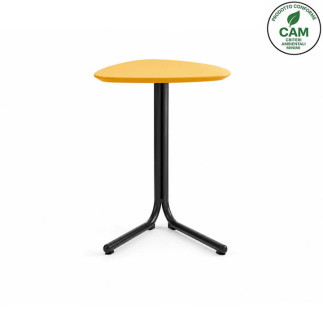
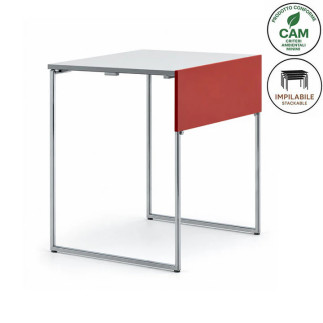
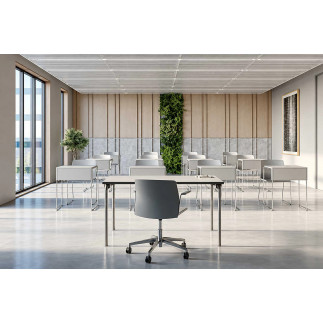
Tables for Classrooms, Training Rooms, Corporate Training and Multipurpose Spaces
Training and educational tables are designed to furnish spaces dedicated to learning, professional training, corporate courses, lessons and collaborative activities.
Schools, universities, training centres, companies and conference hotels may have very different requirements, but they all share a common need: creating functional workstations that are easy to arrange and suitable for the activities being carried out.
Isarreda offers a selection of classroom tables, single-student desks and training room tables, with solutions designed for schools, universities and professional environments.
The range includes individual workstations, stackable tables, folding models, tables with castors and flip-top surfaces, and systems designed to be connected or reconfigured.
Depending on the model, different sizes, materials, colours and finishes are available, allowing tables, seating and other furniture to be coordinated throughout the room.
Why Choose Isarreda Training and Educational Tables?
-
Versatile applications: single-person tables and desks for schools, universities, academies, training centres and training rooms.
-
Single-person tables: individual workstations designed for writing, studying and using educational materials.
-
Stackable and folding tables: help save space when the room needs to be cleared.
-
Quality for frequent use: particular attention to stability, structure, edges, surfaces and mechanisms.
-
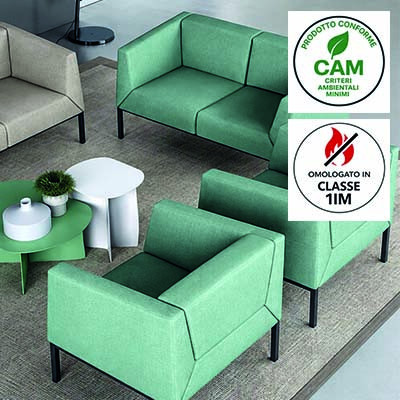
CAM and fire reaction requirements: models compliant with the Italian Minimum Environmental Criteria (CAM) and certified to Italian Fire Resistance Class 1IM are available, where supported by the relevant product documentation.
Classroom Tables
Classroom tables form the foundation of each student's or participant's workstation. They must provide sufficient surface space for writing, books, handouts, laptops and tablets.
The choice of dimensions depends on the type of activity. A predominantly theoretical course may require a relatively compact surface, while a classroom where computers, documents and work equipment are used simultaneously may require a larger tabletop.
For this reason, classroom planning should always begin with the activities being carried out, rather than simply the maximum number of tables that can fit into the room.
Single-Person Training Tables
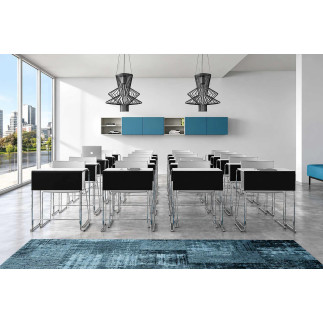
Single-person tables provide each participant with an individual workstation. They are particularly suitable for lectures, professional courses and corporate training, as well as public institutions such as schools and universities and venues hosting examinations or competitive selection procedures.
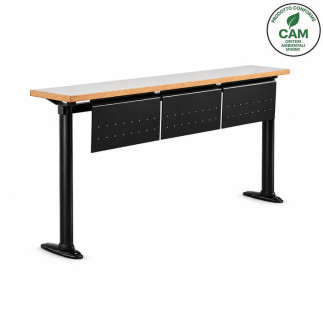
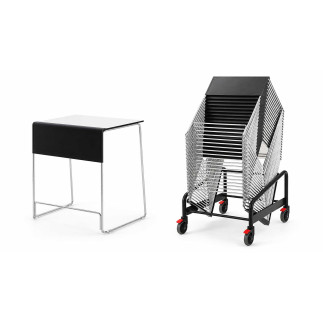
The Isarreda catalogue includes models specifically designed for classrooms and training environments, including the Snap single-person tables by Leyform.
Individual workstations also make it easier to rearrange the classroom layout compared with a large shared table.
Single-Person Tables with Bag Hooks
A seemingly simple feature such as a bag hook can significantly improve workstation organisation. In a classroom, each participant may have backpacks, bags or jackets.
A dedicated hook helps prevent bags and backpacks from taking up desk space or being left in walkways.
Single-Student School Desks
Single-student school desks should be selected according to the age of the users, workstation dimensions, type of activity and length of lessons.
For school furniture, it is particularly important to check desk height, tabletop dimensions and available legroom.
Compliance with the Italian Minimum Environmental Criteria (CAM) for indoor furniture refers, in the case of school furniture, to UNI EN 1729 Parts 1 and 2, concerning chairs and tables for educational institutions.
Compliance must always be verified for each individual product.
University Tables
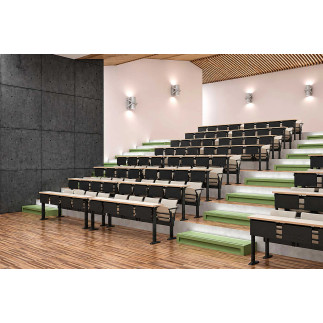
University classrooms can be furnished with individual tables, shared workstations or floor-fixed systems.
The layout depends on the room's intended purpose. A seminar or workshop room may benefit from a mobile system, while a lecture hall with a permanent layout may require beam-mounted desks or fixed seating systems.
When arranging tables, it is also important to consider visibility of the lecturer and screen, spacing between rows, accessibility, circulation routes and any power supply systems.
Training Room Tables
Training room tables are designed for spaces used for professional training, continuing education and workshops.
They can be used in companies, training institutions, business hotels and, of course, schools and universities.
Training rooms can be arranged in very different ways depending on the activities taking place. For this reason, table flexibility can become a key selection criterion.
Tables for Corporate Training and Workshops
Companies increasingly organise activities such as technical training, health and safety courses and professional development programmes.
Corporate training tables must therefore make it possible to create environments suitable for both classroom-style instruction and group work.
Professional training table systems are specifically designed to allow individual, connected, U-shaped or clustered configurations.
A workshop has different requirements from a traditional lesson. During the activity, participants may need to work in groups, share documents and use laptops.
For this reason, movable and modular tables are particularly suitable, allowing the room to switch from a classroom-style layout to group seating arrangements.
Tables for Multipurpose Rooms
Multipurpose rooms must be able to serve different functions throughout the day.
The same space may host a training course, a meeting, a workshop or a conference. In these situations, heavy, fixed tables may limit how the room can be used.
Folding, stackable or mobile tables provide greater flexibility.
Folding Training Tables
Folding training tables help reduce the amount of space required when a room needs to be cleared.
The structure may feature folding legs or a flip-top mechanism.
Isarreda offers a wide selection of tables with folding legs designed for meetings, training courses, conferences and multipurpose environments.
Their main advantage is the ability to use the same room for a wide range of activities.
The addition of castors with locking brakes makes rearranging the room easier. Staff can quickly switch between rows, group arrangements, classroom-style layouts, U-shaped configurations and open spaces.
Flip-Top Tables
Flip-top tables feature tabletops that can be moved into a vertical position.
This allows several tables to be positioned close together, reducing the space required for storage.
They are particularly suitable for training rooms, hotels, conference centres, offices and corporate academies.
Stackable Tables and Table Trolleys
Stackable classroom tables can be stacked when not in use.
They are particularly useful when storage space is limited, the room changes function throughout the day or a large number of workstations must be managed.
For larger furniture supplies, handling and transportation become an integral part of the project.
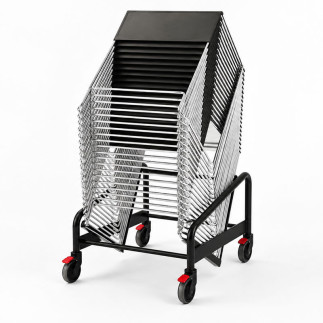
A table trolley can simplify transportation, storage and, above all, day-to-day management.
The Isarreda catalogue also includes trolleys specifically designed for transporting Snap tables.
Training Tables for Hotels
Conference hotels represent an important application for training furniture.
Hospitality venues may host training courses, conferences, meetings and corporate events.
Rooms used for different activities require furniture that can be easily reconfigured.
Folding tables, tables with castors, flip-top models, connectable systems and stackable tables are therefore particularly suitable.
Training Tables for Business Centres
In business centres, meeting and training rooms may be used by different companies every day.
A flexible layout allows spaces to accommodate small training sessions, larger groups, meetings, seminars and workshops.
The same applies to coworking spaces and corporate academies, where environments must be increasingly flexible and versatile.
Table selection should therefore also take into account how easily staff can change the room layout.
Mobile and reconfigurable solutions allow the available floor space to be used more efficiently.
Customisable Training Tables
Customisable training tables allow furniture to be adapted to the environment and the organisation's visual identity.
Depending on the collection, different dimensions, shapes, materials and colours may be available.
A school may choose neutral, functional colours, while a company may coordinate its tables with its corporate colour palette and existing office furniture.
Hotels may select finishes that complement their meeting rooms and conference facilities.
Materials should be selected according to frequency of use, maintenance requirements, handling, cleaning and intended application.
One of the materials commonly used for tabletops is HPL (High-Pressure Laminate), which is used on certain educational tables because it allows the creation of compact surfaces suitable for frequent use.
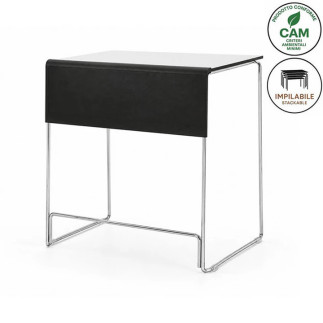
An example from the Isarreda catalogue is the Snap single-person desk, featuring an HPL tabletop.
Surface selection should always reflect the activities carried out and the manufacturer's maintenance instructions.
Quality of Training Tables
When selecting a professional training table, it is important to assess specific characteristics, including stability, structural strength and durability, reliability of opening mechanisms and ease of maintenance.
Tables intended for classrooms, courses and training activities may be moved and used repeatedly throughout the day.
For this reason, mechanisms and components must be suitable for the intended frequency and type of use.
CAM Compliance for Educational Tables and Furniture
The CAM – Minimum Environmental Criteria (Criteri Ambientali Minimi) are particularly important for furniture supplied to public administrations, schools and institutions in Italy.
The CAM requirements for indoor furniture explicitly include school furniture and refer, among other technical standards, to UNI EN 1729 Parts 1 and 2, covering chairs and tables for educational institutions.
Isarreda offers CAM-compliant models when the relevant requirements are documented by the manufacturer.
The catalogue includes, for example, the Snap Edu CAM-Compliant Single-Student Desk by Leyform.
Training Tables and Sustainability
Sustainability can be assessed through several factors, including CAM compliance, the use of recycled or recyclable materials, durability, repairability and the possibility of replacing individual components.
It is important to distinguish between recycled and recyclable materials, as these characteristics are not equivalent.
How to Design a Training Classroom
Selecting the right training tables should begin with a few essential questions.
-
How many people must the room accommodate? This determines the number and dimensions of the workstations.
-
What type of activities will take place? Classroom-style lessons, workshops and digital training require different layouts.
-
Will the room layout need to change frequently? If so, mobile, folding or stackable tables may be useful.
-
Will participants use laptops? It is important to provide sufficient tabletop space.
-
Is storage space required? The dimensions of tables when folded or stacked should be considered before purchasing.
-
Are the tables intended for a school or university? Relevant requirements and standards must be checked.
-
Is CAM compliance required? This requirement must be verified in the documentation for the selected model.
Why Choose Isarreda for Training and Educational Tables?
Choosing Isarreda for training and educational tables means being able to design a classroom around the activities that will actually take place.
Schools can select single-student desks that comply with the applicable requirements.
Companies can create easily reconfigurable training rooms.
Universities can arrange individual or shared workstations, while hotels can equip training rooms that can also be used for meetings and conferences.
The availability of single-person, stackable, folding, mobile and flip-top tables, together with different dimensions, materials and finishes, makes it possible to create more functional spaces that are easier to manage.
The goal is not simply to furnish a classroom, but to create an environment capable of supporting training, learning and collaboration over time.